All Photos posted on this blog unless otherwise noted were taken by me with my Canon Rebel XTI using a 300 mm zoom lens

Monday, April 1, 2013

April 2013 Bird of the Month Killdeer


The Killdeer is a handsome Plover that can be found in several different habitats. Though it is a shore bird and can be found on the shores of lakes and ponds it can also be found on grassy areas of parks and golf courses, fields, and parking lots. Killdeer are common at Farmington Bay and on the shore of the Great Salt Lake. 
Killdeer are permanent residents of the Great Salt Lake Wetlands. One of the first pictures I ever took of a bird was in January 1977 having just returned from 2 years in the philippines I went with my dad to Farmington Bay to take pictures. I took a picture on a cold and foggy day of a very cold and lonely looking Killdeer in a small pond. It was a great picture that hung in my KFC restaurant for many years. I have long ago left KFC and lost the picture but not the memory of that day.

Killdeer often nest on the gravel shoulder of the Nature Center Parking Lot
Speckled Eggs in a gravel nest
Always running along the parking lot calling Kill-Deer, Kill Deer getting very nervous if anyone or anything gets close tho their nest they will try to lure you away from the nest.
They will fake a broken wing making themselves look like easy prey distracting predators way from the nest.
Wading feeding on aquatic invertebrates.
Searching for insects in grassy areas.

Sunday, March 10, 2013

March 2013 Bird of the Month Tundra Swan

Tundra Swan coming in for a landing
The Tundra Swan nests on the Northern Tundras of North America and winters along the coasts of the United States and many winter in the wetlands of the Great Salt Lake. Once the duck hunt is over in Mid January the Tundra Swans start showing up in large numbers at Farmington Bay. Before that they can be seen in large groups on the Great Salt Lake and other areas on the Northern end of Great Salt Lake.

Tundra Swans, Pintails, Canada Geese and Gulls at Farmington Bay
I never saw a Swan in the wild until I started Volunteering at Farmington Bay. The day I took most of these pictures in February of 2008 I had to get out of the house. I had spent 3 days in the hospital with pneumonia, I had been home for a few days and was still weak but feeling better and needed some air and sun. I went out to Farmington Bay and took about 300 pictures of the swans.

Tundra Swans, Green-winged Teal and Pintails
The Swan in the center of the picture is a Bewick's race Tundra Swan. Notice the larger yellow patches on the face. Each year we get one or two Bewick's Swans.
Tundra Swans with Canvasbacks, Pintails and Ring-billed Gulls
Swans at Bear River Bird Refuge 

Monday, February 25, 2013

Time to do something different


I mentioned in a prior post that I had broken my zoom lens, during the several months without a lens I took time to do some drawing. It had been a long time and it was great fun. Here is one of the pictures I drew in the last couple of months. Below is the photo that I used as my model.


I posted some other pictures on our family blog, if anyone is interested. I will continue to practice, I have really enjoyed drawing. 

Sunday, February 17, 2013

Eagles and More Eagles

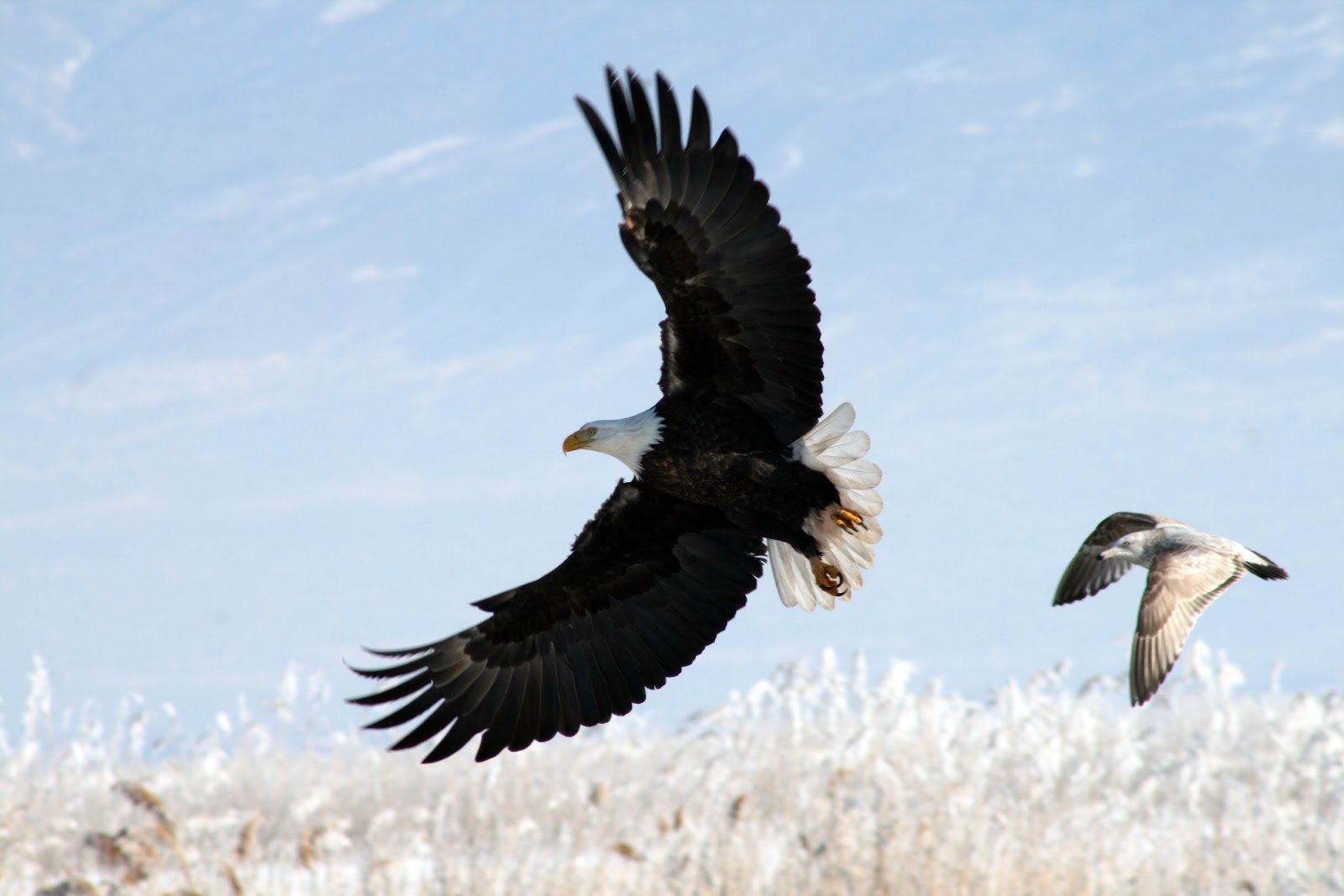
This has been the coldest winter since 1949, cold winters make for great Eagle watching at Farmington Bay.
It's been a long time since I posted, there are several reasons but probably the biggest is I just simply didn't feel inspired to post any thing. I suppose because I have been without a telephoto lens for my camera for several months. That and I worked on a Christmas project in November and December for my grandkids, I will post on that later. I'm back in the saddle now and plan to do more birding and more posting. I hope you enjoy these pictures from my first outing with my new lens.

Eagles roosting in the distance after gorging on carp

Control projects to manage the out of control and destructive carp population in Great Salt Lake Wetland are a great feeding opportunity for wintering Eagles
Gulls and Eagles both opportunistic feeders eating side by side at the carp buffet


Adolescent Bald Eagle
Photogenic Eagles draw hundreds of photographers to Farmington Bay who wait for hours to get the perfect Eagle shot


Plenty of food to go around but still a lot of squabbling over the bits
This and the next picture are my favorite shots of the day

Northern rough-legged Hawk

There were other birds out as well

Northern Harrier feeding on a duck
Common Goldeneye
American Kestrel
Canvasback and Ringneck Ducks
Canvasback and Northern Shoveler Ducks

Saturday, November 3, 2012

November 2012 Bird of the Month, Common Goldeneye

Common Goldeneye are common on the Great Salt Lake wetlands during winter. This picture was taken at Kaysville Pond. Kaysville Pond is a great place each winter to see Common Goldeneye, Ring-necked Ducks and one of the few places in Northern Utah to see Hooded Merganser. In this picture you can see Common Goldeneye, Hooded Mergansers and Gadwalls.
Common Goldeneye nest in Canadian forests and winter throughout most of the United States. They are abundant at Farmington Bay.

Male common Goldeneyes have blackish iridescent green heads with a white circular patch between the eye and the base of the bill. The breast, sides, belly and patch across the secondaries and secondary wing coverts are white. The back, rump and upper tail coverts are black and the tail is grayish-brown. The bill is black and the legs and feet are yellowish. 

The common goldeneye, like the Barrow's Goldeneye, is named for its brilliant yellow iris. This picture of a pair of Common Goldeneye and a pair of Barrow's goldeneye was taken on the Jordan River in Salt Lake County. Barrow's Goldeneye are uncommon in Utah and this was a great sighting for me.
Female common goldeneyes have chocolate brown heads, a whitish neckband, and speckled gray back and sides. The upper wings are brownish-black with the middle five secondaries colored white. The bill is blackish, becoming yellow near the tip, and the legs and feet are yellowish.
This side by side picture of a male Barrow's Goldeneye and a Common Goldeneye shows the field marks that help identify them. The male Barrow's Goldeneye has an iridescent purple head with a large white crescent on its face while the Common Goldeneye had an iridescent dark green head with a round white mark. Both are in my opinion some of the most beautiful waterfowl.
Common goldeneyes fly in small compact clusters, with their wings making a distinctive whistle at every wing beat.
Common goldeneyes use brackish estuarine and saltwater bays and deep freshwater habitats in the winter and dive to feed on a wide variety of available animal life. They feed on aquatic insects, crustaceans and aquatic plants, that makes the Great Salt Lake a perfect winter habitat for the Common Goldeneye.

Sunday, October 7, 2012

October 2012 Bird of the Month, White-faced Ibis


In October from my window at work I watch hundreds of white-faced Ibis flocks pass by flying in formation similar to Canada Geese. White-faced Ibis are abundant around the Great Salt Lake in fact the Great Salt Lake Wetlands are one of the largest breeding areas in North America for White-faced Ibis.


Just what color are White-faced Ibis? It depends on the angle of light you are looking at them. From one angle they look black or dark brown from another angle they are shades of brown purple and green. And why is it called White-faced Ibis. Looking very much like it's eastern cousin the Glossy Ibis which seems a much more fitting name because they are quite glossy. The White-faced Ibis gets its name from the white border around its pink face during the breeding season. The picture above is a good example of both breeding and non breeding markings.

This shot shows the iridescent colors in flight
This picture was taken in late summer, notice the white face is gone. This bird was perched with a group of Black Terns
White-faced Ibis feed in lage flocks in fields, playas and wading in shallow water in marshes. I often see them feeding in fresh plowed field.

White-faced Ibis nest in much of the western United States and winter in Mexico and South America.
White-faced Ibis nest in marshes and are very abundant at Farmington Bay. The latest I have seen White-faced Ibis at Farmington Bay is January, but most have moved on by the end of October.

A beautiful and interesting wading bird the White-faced Ibis is my choice for Bird of the month for October.