All Photos posted on this blog unless otherwise noted were taken by me with my Canon Rebel XTI using a 300 mm zoom lens

Friday, September 21, 2012

Antelope Island, New Life Bird and More

Serendipity, I came to Antelope Island to look for an Oven Bird and White-throated Sparrow that were reported this last week. I did not find those target birds but was thrilled to see my first ever Flammulated Owl thanks to photographer Jack Binch. I had added the Flammulated Owl to my life list a few years ago because on an "Owl Prowl" during the Great Salt Lake Bird Festival a few years ago we did hear one. Now I feel much better about it on my list because now I have actually seen one. Thanks Jack for pointing it out to me. Certainly the highlight of the day.
American Avocets at the Causeway 
Ring-billed Gulls 
Ring-billed Gulls dining at the causeway.
California Gull a Brine Fly feast
Common Raven
Western Meadowlark 
Burrowing Owls
Just before seeing these Burrowing Owls I stopped at the Visitors Center to look for Rock Wrens that are always on the rocks at the rear of the Visitors Center. While changing my lenses I dropped my 300 zoom. It still focuses and take pictures however it will not zoom. so the pictures on this post from here on were taken at 75mm. Guess I better saving my pennies for a new lens. 
Bison were plentiful today
This Coyote was kind enough to pose for me and stay close so I could get several pictures before he had had enough and took off.
I saw several Coyotes today but only this one was close enough to photograph.
Sunflowers and Rabbitbrush were beautiful
Red-tailed Hawk just one of many I saw on the road to the ranch
Another Red-tail
This group of cows and calves took their sweet time crossing the road and I didn't rush them.
I took this though my windshield 
White-crowned Sparrows were abundant over the whole island but I never did see the White-throated Sparrow
Another shot of the Flammulated Owl
Pronghorn Family
Hermit Thrush were everywhere at the Ranch
Pronghorn Doe
Pronghorn and her sister wives
Eared Grebes the one in the center still showing a lot of breeding plumage


Here is a list of birds and more seen today
American Avocet
Black-necked Stilt
California Gull
Ring-billed Gull
Northern Shoveler
Eared Grebe
Brewer's Blackbird
Barn Swallow
Common Raven
Franklin's Gull
Western Meadow Lark
Loggerhead Shrike
Rock Wren
Black-billed Magpie
Burrowing Owl
Red-tailed Hawk
Wilson's Warbler
Cassin's Vireo
Ruby-crowned Kinglet
Song Sparrow
Spotted Towhee
Hermit Thrush
Northern Flicker
Oregon Dark-eyed Junco
Empid Flycatchers
Yellow-rumped Warbler
American Redstart
Western Sandpipers and other Peeps, I forgot my scope so today they were just peeps
Long-billed Curlew
California Quail
Other animals
Pronghorn
Bison
Coyote


Saturday, September 15, 2012

Labor Day at Farmington Bay

American White Pelican and Canada Geese, I was not quite fast enough to catch a shot of the Pelican biting the head of the goose that got just a little to close to the Pelicans little island. 
Pelicans were abundant and active they are great subjects to photograph
Pelicans cooperative feeding on Glover Pond
A view from Goose-egg Island toward the Northwest, there were Snowy Egret, Canada Geese, White-faced Ibis and Blue Heron
Snow Egret with the Heron Rookery in the background. The Power company came out a couple of weeks ago to replace some of the poles of the rookery that were blown over last winter during a wind storm. However they were unable to proceed when they found several not quite ready to fledge baby Barn Owls in the nest box. The Poles will be replaced at a later date.
A view from Goose-egg Island of Northern Harriers hunting, or are they?

Are they hunting, fighting for territory or just playing?
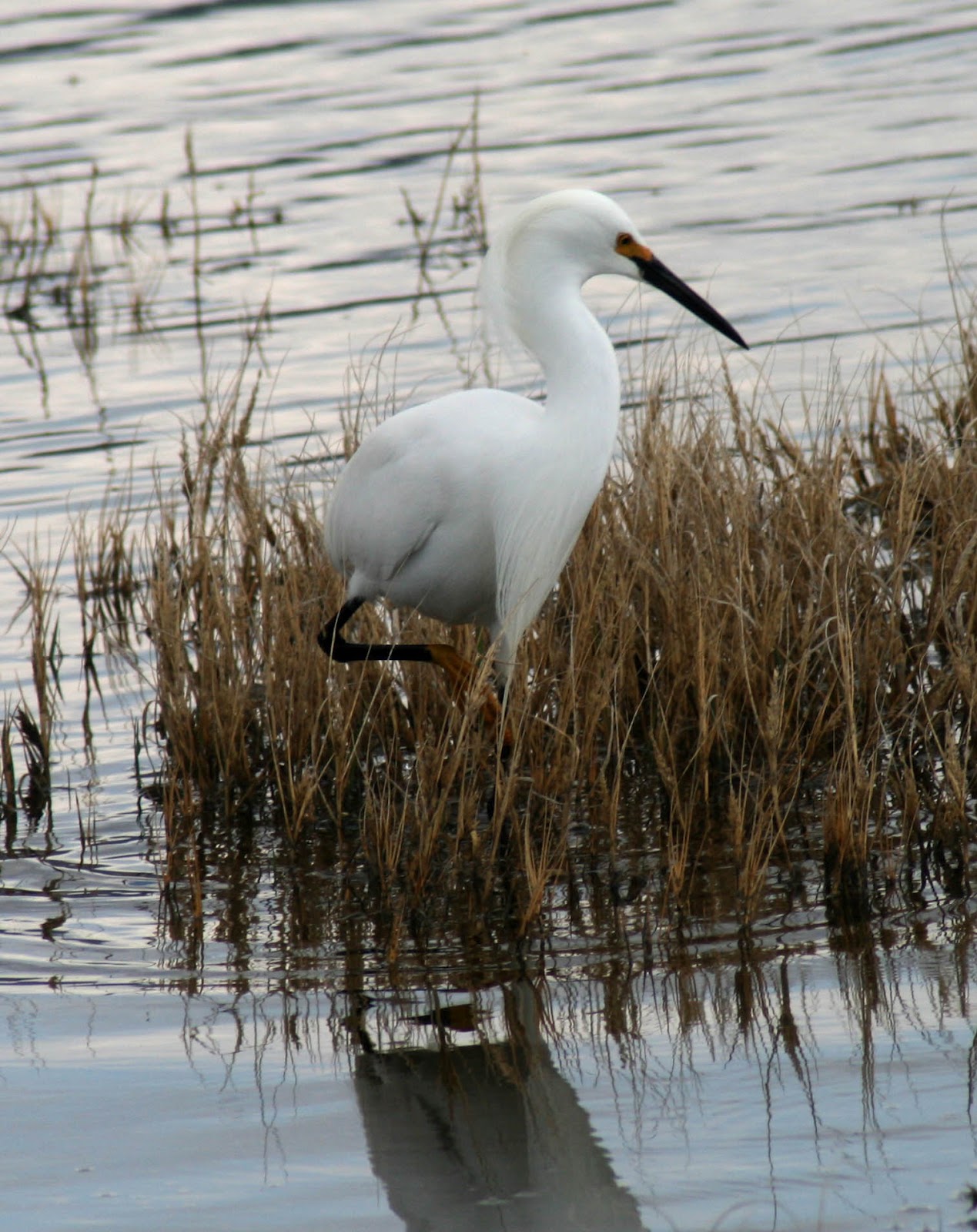
Snowy Egrets are common at Farmington Bay but their numbers seem greater this year than most, and Cattle Egrets I have never seen as many as I have this year.
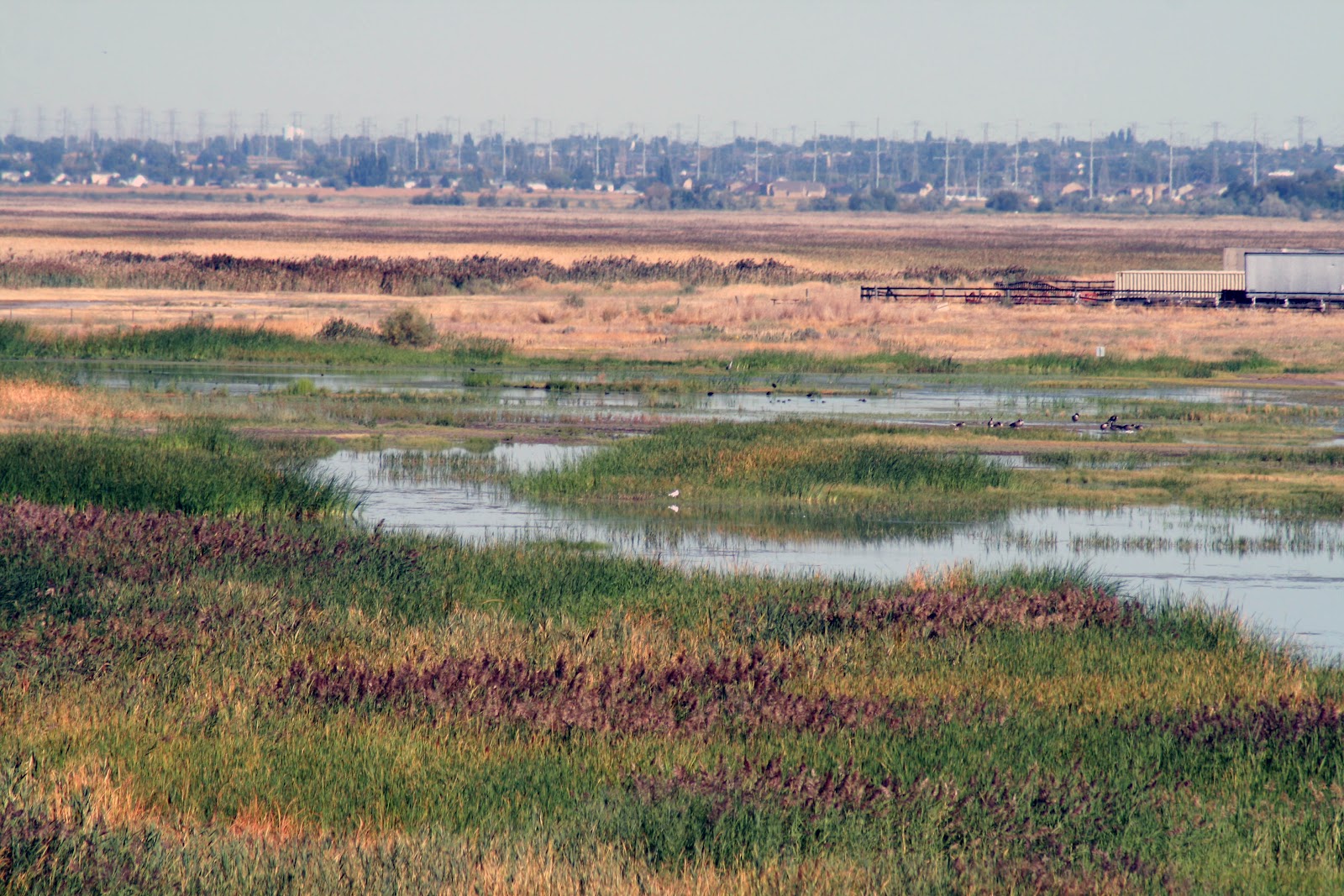
This is where it all starts here at Farmington Bay, the water is full of life. There are abundant invertebrates, mollusks, frogs and fish in addition to the vegetation. There were many minnows but hard to see them in the picture. 
The big pond on the nature trail. With such a great riparian area at the east end of the pond I have always wondered why the Egrets and Herons don't nest here. After my trip to Greeley Colorado last spring when I saw hundreds of Egrets and Herons nesting in trees at a city park I have wondered why in this what seems to be a perfect spot they don't nest in these trees.
More of the big pond
Viewing Decks on the big pond

This was encouraging, this Great Blue Heron was sitting in the trees at the east end of the pond
A Muskrat in the big pond
These next pictures are of the beautiful late summer flowers on the Nature Trail

Cattails and Showy Goldeneye
Lupine
Hard-stem Bullrush, Sunflowers and Cattails 
The yellow flowers are Curley-cup Gumweed, I don't know the name of the purple flowers but they are beautiful.
Double-crested Cormorant
This canal runs along the south part of the Nature Trail and has been the source of some great birding over the years.
Great Blue Heron 
It was a beautiful day at Farmington Bay a place I seem to be finding harder and harder to get to. 

Tuesday, September 4, 2012

September 2012 Bird of the Month Black-crowned Night Heron


I saw my first Black-crowned Night Heron many years before I started keeping a life list on a golf course. I thought it was one of the strangest looking birds I had ever seen. I had seen Great Blue Herons and to me it looked similar but with no neck. Black-crowned night-herons do not fit the typical body form of the heron family. They are relatively stocky and about 25 inches tall with shorter bills, legs, and necks than their more familiar cousins the egrets and "day" herons.


Adult black-crowned night-herons have black caps and backs, pale gray wings, white underparts, red eyes, and yellow legs. Two or three long white plumes, erected in greeting and courtship displays, extend from the back of the head. The sexes are similar in appearance although the males are slightly larger.


Black-crowned night-herons usually nest in colonies with other Herons and Egrets, the picture above is a rookery of Night Herons, Snowy Egrets and Cattle Egrets in Greeley Colorado.


Black-crowned Night Herons are found on every continent except Antarctica and Australia. They are the most widely distributed Heron.

Juvenile Black-crowned Night Heron
Immature birds have dull gray-brown plumage on their heads, wings, and backs, with numerous pale spots. Their underparts are paler and streaked with brown. The first time I saw a juvenile BC Night Heron I got excited and thought for sure I had seem my first American Bittern but close inspection and consulting my field guide determined it was a juvenile BC Night Heron. I did finally see an American Bittern at the Federal Bird Refuge at Bear lake Utah. and it's the only one I have ever seen and don't have any pictures.

Black-crowned Night herons are abundant at Farmington Bay, I love to be out there at dusk when they get active and they seem to come out of everywhere.

Tuesday, July 31, 2012

August 2012 Bird of the Month Great Egret


The great egret is a little over three feet tall with a wingspan of almost five feet. Its feathers are entirely white. It has a long, sharp yellow bill and long gray to black legs, with non-webbed feet with very long toes. Males and females look alike, but the males are a little larger.


The great egret feeds alone in shallow water. It stalks prey like frogs, crayfish, snakes, snails and fish. When it spots its prey, it pulls its head and long neck back and then quickly stabs at the prey. On land it sometimes stalks small mammals like moles and mice. I have never seen them feed on land but I have posted pictures of Great Blue Herons hunting voles when all the water at Farmington Bay was frozen over a few years ago.


Great Blue Heron hunting Voles
The Great Blue Heron is much more common in Northern Utah than the Great Egret. Seeing a Great Egret in Northern Utah is uncommon and a welcome event. 


The male great egret chooses the nesting site and builds a nest platform of sticks and twigs in a tree or bush before he selects a mate. Occasionally, the great egret will build its nest on dry ground near a marsh. The female great egret lays three to five pale green-blue eggs. The eggs take about three to four weeks to incubate. Both parents incubate the eggs and feed the chicks. The chicks fledge in about six weeks. If the nest is on the ground, the chicks will walk around the nest before they fledge. Both the male and female aggressively defend the nesting territory. Great egrets nest in colonies, often with herons and ibis.


Most range maps do not include Northern Utah, one of the great things about the Great Salt Lake is the vast variety of unlikely birds that show up at our wetlands. 


Sunday, July 15, 2012

July 2012 Bird of the Month, Snowy Egret


The most elegant of all North American Shore and wading birds the Snowy Egret is my selection for Bird of the Month for July.


The Snowy Egret is a medium sized white heron with a slender black bill, black legs and yellow feet. The area of the upper bill is yellow and turns red during breeding season. Elegant plumes of white feathers are present during breeding season.

This rookery in Greeley Colorado hosted nesting Snowy Egrets, Cattle Egrets and Black-crowned Night Herons
Highly colonial Snowy Egrets nest in mixed colonies with other herons. Both fresh and saltwater habitats are used for nesting. My visit to Greeley Colorado was the first time I saw Snowy Egrets nesting in trees. In eastern US areas Snowy Egrets nest mostly in trees or shrubs but in the west ground nests are more common.

Snow Egret with an American Avocet in the foreground sitting on a nest

Snowy Egrets forage in many types of aquatic habitats, both freshwater and marine for small fish, crustaceans and invertebrates. Feeding areas include salt marsh pools, tidal channels, shallow bays, and mangroves. 

Snowy Egret with Black Terns late summer at Farmington Bay
Snowy Egrets nest at the Great Salt Lake wetlands but migrate south to southern states and Mexico during winter.

The Great Egret looks similar to the Snowy Egret but is much larger, The Great Egret has a yellow bill black legs and and black feet.
Cattle Egret is about the same size as the Snowy Egret but lacks the elegant plumes, has a shorter yellow bill and legs and during breeding has rusty colored markings on the breast and head.