All Photos posted on this blog unless otherwise noted were taken by me with my Canon Rebel XTI using a 300 mm zoom lens

Tuesday, November 30, 2010

Rough-legged Hawk December 2010 Bird of the Month


My pick for bird of the month for December is our wintering Buteo the Rough-legged Hawk. Winter is raptor time in the valley of the Great Salt Lake, though the Swainson's Hawks have gone south for the winter the Red-tails, Harriers, Kestrels, Short-eared Owls, Great Horned Owls and even Barn Owls our permanent residents are more visible than any other time of year. In addition the Rough-legged Hawks, Merlins and Bald Eagles come from the North Country to enjoy our balmy winters.

Rough-legged hawks are abundant at Farmington Bay from November through March. I think they have  the most beautiful markings of any raptor under their wings as they soar overhead. 


The Rough-legged Hawk breeds in Arctic tundra and taiga regions around the northern hemisphere. 

Description

  • Large Buteo.
  • Wings long and broad.
  • Flight feathers pale, with dark trailing edge to wings.
  • Black wrists marks.
  • Tail broad, white at base and broad dark tip.
  • Commonly pale, streaked chest and broad dark belly.
  • May be all dark, still with pale wing feathers and white at base of tail.


The name "Rough-legged" Hawk refers to it's feathered legs. The Rough-legged Hawk, the Ferruginous Hawk, and the Golden Eagle are the only American raptors to have legs feathered all the way to the toes.

Sunday, November 21, 2010

Woodpeckers

Downy Woodpecker
In my opinion, some of the most beautiful birds are woodpeckers. On my life list I have been fortunate enough to have added several species, unfortunately I have not been able to photograph most of them. 
Woodpeckers I have added to my life list are... Downy Woodpecker, Hairy Woodpecker, Northern Flicker red and yellow-shafted, Red-naped Sapsucker, Red-bellied Woodpecker, Red-headed Woodpecker, Acorn Woodpecker, Ladder-backed Woodpecker and most recently I saw a Great Spotted Woodpecker during our trip to Europe. Of all of these I have only been able to photograph, Downy Woodpeckers and Northern Flickers. I am setting a goal of spotting several more species in 2011 and adding many more Woodpecker photos to my library. 
Here are some of the pictures I do have.
Female Downy Woodpecker
Male Downy Woodpecker


Northern Flicker (Red-shafted) male

Red-shafted Flicker; not a great picture but it does show the field marks.

Friday, November 12, 2010

Autumn Birding at Antelope Island

Hermit Thrush
Bonapart's and California Gulls
Frank Clawson and I took a trip out to Antelope Island Thursday one of my favorite places on earth. We had a wonderful time and saw some good birds though we missed the target bird, the Varied Thrush. For a couple of years I have gone out to Antelope Island hoping to see a Varied thrush. They have been reported there for several years. Last time I went in early September I did get the Northern Water Thrush finally but no picture.

Here is a list of birds and other wildlife seen on yesterday's trip...

Least Sandpiper
Killdeer
California Gull
Ring-billed Gull
Bonapart's Gull
Tundra Swan
Eared Grebe
Loggerhead Shrike
Bewick's Wren
Black-billed Magpie
Red-winged Blackbird
Red-tailed Hawk
American Kestrel
European Starling
Common Yellowthroat
Dark-eyed Junco
Hermit Thrush
Great Horned Owl
Other Wildlife...
Bison
Pronghorn
Mule Deer
Coyote

Here are some pictures.
Bonapart's, and California Gulls

Loggerhead Shrike
Loggerhead Shrike

Hermit Thrush

Great Horned Owl
Great Horned Owl
Bison
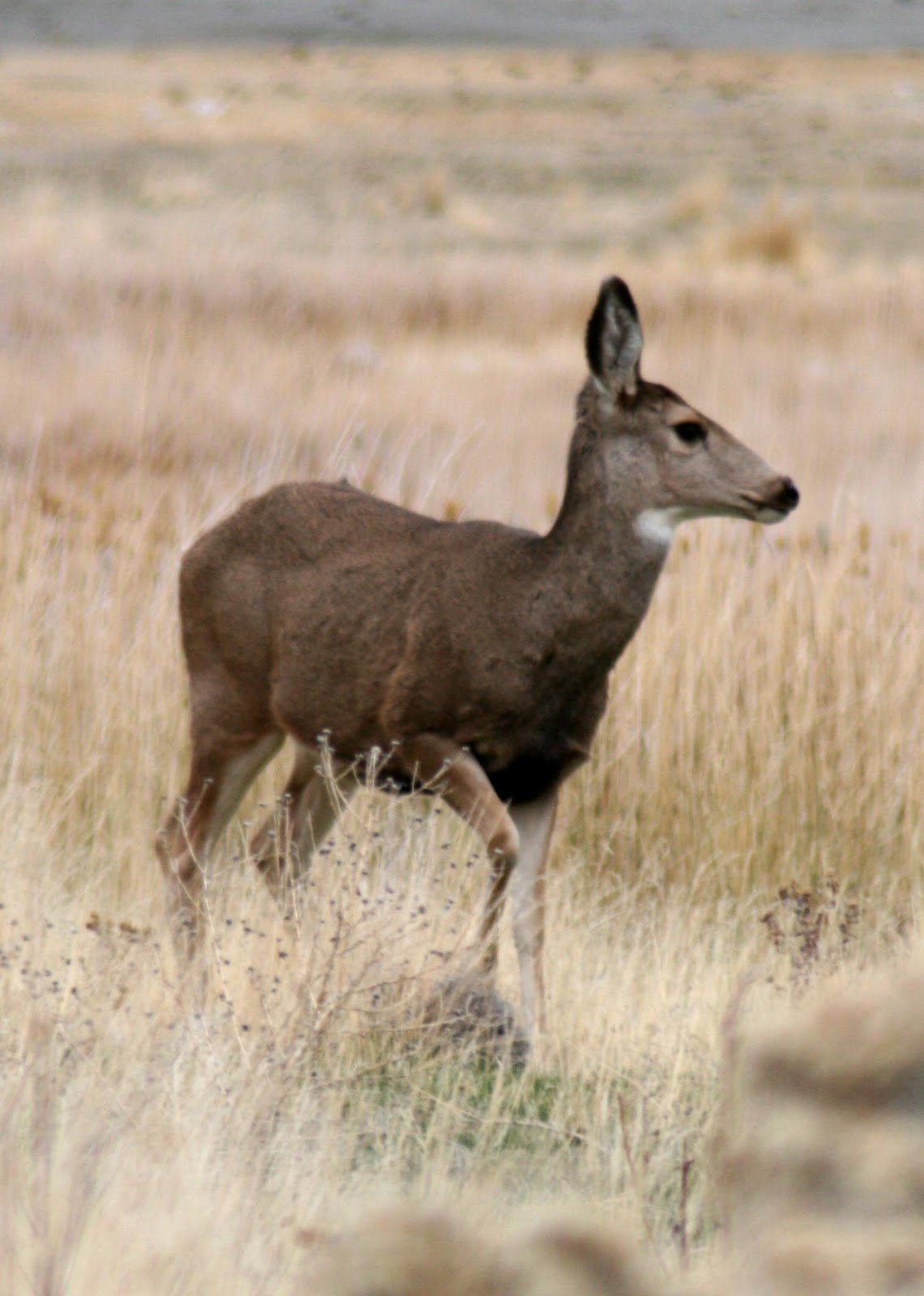
Mule Deer
Coyote
Mule Deer

Sunday, October 31, 2010

RED-TAILED HAWK NOVEMBER 2010 BIRD OF THE MONTH

Every once in a while I get a lucky shot with my Canon, this is one of those lucky shots

The Red-tailed Hawk most common and often seen of the Buteos here along the Wasatch Front, if you watch the power poles along any freeway or highway in Northern Utah you are likely to see at least one Red-tailed Hawk perched sitting and waiting for a mouse, meadow vole or other easy prey to dive down on.

My first recollection of a Red-tailed hawk which everyone back then called a chicken hawk, was when I was a child maybe seven or eight years old and our neighbor across the street the mighty hunter came home from a hunting trip with a Red-tail he had shot and wounded. Of course all the boys in the neighborhood were curious and excited, to see this "chicken hawk". His intent was to give it to a couple of brothers in our neighborhood to keep as a pet. I was the first to attempt to pick up this scared and angry bird not realizing how sharp it was. He promptly sliced my finger with his razor sharp talons ending my desire to hold it. 

I have thought about that many times in the past 40 plus years and realized how much the world has changed. Just imagine a man bringing home a hawk he had shot and wounded which is illegal and carries a great fine and punishment but then to allow small children to then play with it. This would now be considered animal cruelty, poaching, and above all irresponsible to the animal and to the children.

I don't remember what ended up happening to that hawk but I do know it was one of the experiences in my life that lead to my respect, interest in and love for birds.

Red-tails are year round residents in Utah and many are hatched each year at and around Farmington Bay. All of these pictures were taken at Farmington Bay.


  • Size & Shape

    Red-tailed Hawks are large hawks with typical Buteo proportions: very broad, rounded wings and a short, wide tail. Large females seen from a distance might fool you into thinking you’re seeing an eagle. (Until an actual eagle comes along.)
  • Color Pattern

    Most Red-tailed Hawks are rich brown above and pale below, with a streaked belly and, on the wing underside, a dark bar between shoulder and wrist. The tail is usually pale below and cinnamon-red above, though in young birds it’s brown and banded. “Dark-phase” birds are all chocolate-brown with a warm red tail. “Rufous-phase” birds are reddish-brown on the chest with a dark belly.
  • Behavior

    You’ll most likely see Red-tailed Hawks soaring in wide circles high over a field. When flapping, their wingbeats are heavy. In high winds they may face into the wind and hover without flapping, eyes fixed on the ground. They attack in a slow, controlled dive with legs outstretched – much different from a falcon’s stoop.
  • Habitat

    The Red-tailed Hawk is a bird of open country. Look for it along fields and perched on telephones poles, fenceposts, or trees standing alone or along edges of fields.


Similar Species

The first step with identifying any hawk is to use its size and shape to decide what type you're looking at. Is it one of the three main groups: buteo, accipiter, or falcon? Buteos have broad, rounded wings and short, wide tails, and you often see them soaring without flapping. Red-shouldered Hawks, another common buteo, tend to be smaller than Red-tails with a banded tail and warm brown barring below. Swainson's Hawk has a dark trailing edge to the underside of the wing, and a dark chest. From a distance you might confuse a soaring Red-tail with aTurkey Vulture (also very common across North America in summer), but Turkey Vultures have longer, more rectangular wings, which the birds hold above horizontal, forming an easily visible V. Turkey Vultures are also much less steady when they soar.
Red-tailed Hawks have extremely variable plumage, and some of this variation is regional. A Great Plains race called "Krider's" hawk is pale, with a whitish head and washed-out pink in the tail. Light-phase western birds tend to be more streaky on the underparts than eastern Red-tails; south Texas forms are darker above, without the dark belly band most other Red-tails have. Dark-phase birds can occur anywhere but are more common in western North America - particularly in Alaska and northwest Canada, where the all-dark "Harlan's" race is common.
Dining on a muskrat
The Red-tailed Hawk has a thrilling, raspy scream that sounds exactly like a raptor should sound. At least, that’s what Hollywood directors seem to think. Whenever a hawk or eagle appears onscreen, no matter what species, the shrill cry on the soundtrack is almost always a Red-tailed Hawk.
This could have been so much better my only opportunity so far to shoot a dark morph Red-tail and my camera acted up, fortunately I at least got this less than wonderful shot

Tuesday, October 26, 2010

American Robin and The Common or Eurasian Blackbird

Common or Eurasian Black Bird
American Robin

My amateur observation of these 2 thrushes that look nothing alike but in my observation their behavior and vocalizations are very similar.

On my first evening in Germany I took a walk through a park and bicycle path to do some birding. The second bird I saw was the Common Blackbird. Later after walking for about an hour and it was getting dark I heard in the bushes a familiar sounding call. It sounded like the call of an excited American Robin. Since I didn't see the bird I assumed it might be a European Robin, a bird I later found in my opinion to not have much in common with the American Robin. The next day I walked through the  Nuremberg Cemetery and there found that the bird I heard the night before and assumed to be a European Robin was actually the Common Blackbird. 
Common Blackbird bathing in a puddle
American Robin in my backyard
European Robin
Throughout the remainder of our visit I watched the Blackbirds birds fly over in groups, forage on lawns and gardens just like our American Robin.


Though they don't look a lot alike I found them to be very close in sound and behavior. I would love comments from any of you who is more familiar with both of these species than I am.

Tuesday, October 12, 2010

More Pictures of European Birds

I took over 2000 pictures on our trip to Germany and Italy, after we got home I sorted them and placed them in files according to place. The bird pictures I sorted by species, in doing so I found some pictures I had missed including in my prior posts so here are some more pictures of birds. Not the greatest pictures but the best I've got. It was such a wonderful holiday and for me was like two holidays. one visiting the different cities and spending time with Nery my daughter and her fiancee and his family, which I have posted on our family blog. The other is the three days spent birding.
Wood Pigeon
Eurasian Tree Sparrow, looks a lot like the House Sparrow but notice the black mark on the cheek
Willow Warbler
Common Moorhen 
Magpie, looks a lot like our black-billed Magpie but smaller and the voice is different
Long-tailed Tit
Hawfinch
Chaffinch
European Goldfinch

Tuesday, October 5, 2010

Bird number 300 on my life list and more European Birding

Bird number 300 on my life list is the Black Redstart seen first in Como Italy
I have been able to do some more birding and have added 8 new birds to my life list since my last post. I counted my life birds and found that the Black Redstart I spotted in Como Italy is number 300 on my life list.

I have found birds here much more difficult to approach than in Utah, making getting pictures rather difficult. The only bird that is easily approached is the Great Tit and they often buzz me while I am birding. Here is a list of birds seen including new life birds, a couple of mystery geese and a few more pictures.
*Common Magpie
Blue Tit
Common Raven
Great Tit
Common Blackbird
European Robin quite common but very skiddish very difficult to photograph
Wood Pigeon
Black Redstart quite common but very difficult to approach.
*Common Buzzard
*Great Cormorant
*Fieldfare
*Graylag Goose
In this group of Graylag Geese were a couple of hybrids one looks like a possible Canada Goose or Barnacle Goose hybrid, I don't know, if any one can shed some light please leave a comment.
Canada or Barnacle Goose hybrid?
Domestic/Bean Goose Hybrid?
Blackcap
Eurasian Jay quite common but not nearly as bold as Scrub Jays back home they are quite difficult to approach.
Eurasian Nuthatch very common and quite approachable
*Greenfinch
 *Eurasian Coot
*Great Spotted Woodpecker
*Marsh Tit
*Sparrow Hawk
Carrion Crow
Common Raven
Chiffchaff
House Sparrow
Eurasian Tree Sparrow
Juvinile Common Moorhen
Adult Common Moorhen