All Photos posted on this blog unless otherwise noted were taken by me with my Canon Rebel XTI using a 300 mm zoom lens

Tuesday, September 8, 2009

My Hook Bird Story


Like most boys growing up in the '60s and '70s, I got a BB gun for Christmas when I was 10 years old. It was great sport for the kids in our neighborhood to go to the local cemetery and shoot sparrows. One day the next summer I was in my backyard and a bird we called a "yellow breasted robin" made the mistake of landing on the power lines in our yard. I raised my BB gun and shot, it fell to the ground and I ran to pick it up. It was not dead and as I held it in my hands I began to feel the same dread that little Opie Taylor felt in the "Andy Griffith" episode when Opie shot a sparrow with a slingshot. As I looked into the face of this poor bird that seemed to be saying with his eyes, "Why did you do this?" I agonized for what I had done and suddenly felt responsible and obligated to helping this poor creature survive if it were still possible. I nursed it for several days, feeding it grasshoppers, hoping it would recover. Fortunately the BB did not penetrate the thick breast of the bird and he recovered quickly. Within a few days I took him outside and turned him loose. He hung around our yard the rest of the summer; he didn't seem to have any fear of me even though I had shot him. He seemed to have forgiven me for what I did and I learned to love and appreciate this little bird, which led to my obsession with birds today. Many years later I learned that my yellow-breasted robin was actually a Western kingbird, a species of flycatcher that is common to our area in the summer.

Sunday, September 6, 2009

Why Birding?


I haven't been very diligent in posting on my blog lately, it's been a rough summer. I blew my knee out during the week of the Great Salt Lake Bird Festival and ended up having surgery on it so I haven't spent much time birding. That and I think I lost focus on why I wanted to blog my birding experiences anyway. The real purpose is to document my birding and thoughts for my family and for me and anyone else who might be interested. I always check the comments and Dave and Catie seem to be the only ones who read and comment. Occasionally there have been others for which I am grateful, I always like feed back.

Today I remembered a line from one of my favorite movies, Finding Forrester that says, " the best writing we do is what we write for ourselves". So I am recommitting myself to writing regularly and not only post bird sightings but some of my thoughts on birding and what ever else may be on my mind.

Why birding? I think people who are not birders look on in amazement and how people can become obsessed with this hobby.
As for me I am still a casual birder, I keep a life list that is not all that impressive, after about 12 years of keeping my life list I still haven't reached 300 birds. Birding has benefited my life in many ways, for one it is a release it is a great hobby to relieve stress. It has made me much more aware of and take notice of things going on around me. It has made me several good friends, and most of all it has giving me an opportunity to share my love of nature with others by volunteering at the Nature Center at Farmington Bay.

I do most of my birding with kids that I work with at Farmington Bay to meet their Scouting requirements, I hope that by doing this I can introduce these kids to birds and the environment in a way that they will always remember and gain an appreciation for the birds and the wetlands and therefore do their part to help protect our natural resources.

Well enough for now. Next time I will post about my Hook Bird.

Monday, August 31, 2009

September 2009 Bird of the Month Wilson's Phalarope


Twice a Year, in spring and again in late summer the wetlands and shores of the Great Salt Lake are host to the amazing Wilson's Phalarope. This bird migrates 6000 miles twice a year from it's breeding grounds in the North American Prairies to it's wintering grounds in South America. The Phalarope loves brine shrimp and 70% of the worlds population of Wilson's Phalaropes stage on the shores of the Great Salt Lake during their migration to fatten up for their long journey south.

Unlike most species of birds where the male is the more ornate and brightly colored to attract females the female Wilson's Phalarope is more brightly colored, the female Wilson's Phalarope is also polyandrous, and may mate with several males. Once her eggs are laid she takes off leaving the incubation and care of the eggs and young to the male. She may nest with several males in the same season.

Watching Phalaropes feed is very entertaining. they will swim or spin in circles creating a vortex in the water that draws in brine shrimp or other macro-invertebrates then they will feast on the them. August and September is the time to watch for these birds in wetlands like Farmington Bay and in large numbers along the Causeway to Antelope Island

Sunday, August 2, 2009

AUGUST BIRD OF THE MONTH WESTERN SCRUB JAY


I have chosen the Scrub Jay as Bird of the Month for August. In my opinion the Scrub Jay is one of the most beautiful birds in our area. The Scrub Jay is one of the first birds I was able to ID when I started keeping my life list, they are one of my favorite birds and I love having them in my yard because of their comic nature, their beauty and they are fairly tame.
This year there were at least two nests of Scrub Jays in the pine trees that border our yard and we have had some very tame and comical juvenile Scrubbies hanging out in our yard this summer. Last year my next door neighbor brought over some peanuts they found growing in their yard compliments of the Scrub Jays. I love watching the Scrub Jays gather peanuts and pound them into the ground with their beaks then find a leaf and lay over the top of it. Some people complain that they don't like Scrub Jays because they are so aggressive and noisy and scare off the other birds. I have not found this to be true. While the smaller birds give the Scrub Jays plenty of room when the come around I have not found that the smaller birds are driven off by the Scrub Jays. Here is a little Scrub Jay info

Keys to identification

  • Size & Shape

    A lanky bird with long, floppy tail and an often hunched-over posture.

  • Color Pattern

    Blue and gray above, with a pale underside broken up by a blue necklace. In birds, the color blue depends on lighting, so Western Scrub-Jays often look simply dark.

  • Behavior

    Assertive, vocal, and inquisitive. You’ll often notice scrub-jays silhouetted high in trees, on wires, or on posts where they act as lookouts. In flight seems underpowered and slow, with bouts of fluttering alternating with glides.

  • Habitat

    Look for Western Scrub-Jays in open habitats of the West: oak woodlands and chaparral near the coast and pinyon-juniper woodlands of the interior West; also backyards, pastures, and orchards. Typically, though not always, in lower and drier habitats than Steller’s Jay.

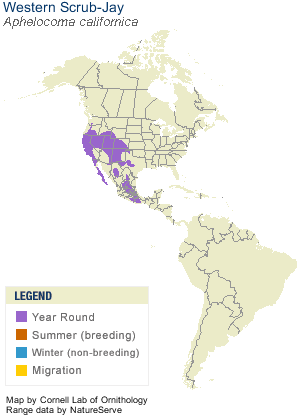
Range Map

Western Scrub-Jay Range Map
View dynamic map of eBird sightings

Tuesday, June 30, 2009

BALD EAGLE JULY'S BIRD OF THE MONTH


What would be more fitting than to spotlight the Bald Eagle our National symbol of freedom as the Bird of the Month for July as we celebrate our nation's independence. When I was growing up here in Northern Utah I never saw a Bald Eagle in the wild. they were on the endangered species list threatened with extinction. Because of the use of DDT pesticide the Bald Eagle and other birds of prey like the Peregrine Falcon numbers were seriously reduced till they were on the brink of extinction. Once the use of DDT was prohibited in the United States, Bald Eagle numbers began to increase and they have made a great come back. Last year the Bald Eagle was removed from the Endangered Species list. Now approximately 1500 Bald Eagles winter in Northern Utah and I have counted as many as 350 Bald Eagles at Farmington Bay. We only have a handful of Bald Eagles that nest in Utah the rest go north to Alaska and Canada to nest, so winter is the time to see them here.

All of these pictures were taken at Farmington Bay.


Friday, June 26, 2009

Common Yellowthroat


One of my favorite summer birds in the marsh is the bumble bee colored Common Yellowthroat with it's unmistakable witchity, witchity, witchity call. My first sighting of the Common Yellowthroat was several years ago at Deseret Ranch, then the next summer while birding the Bear Lake Bird Refuge in Paris Idaho I heard them and got them to come close by pishing. I now listen for them at Farmington Bay and today was able to take a few pictures. They are hard to photograph because they stay down in the Cattails and when the do come up they don't hold still very long.

Sunday, June 21, 2009

Beautiful Singers Of The Sparrow World


Several years ago as I was hiking up to Delicate Arch I heard a bird singing one of the most melodious songs I had ever heard. I looked at it through my binoculars and saw a beautiful little bird with a black throat and white stripes on it's face. I search my field guide hoping that I had spotted some exotic warbler and I have to admit I was a bit disappointed that what I was looking at was a sparrow. It was a Black-throated Sparrow and a new life bird for me though which I was happy for. As a beginning birder I hadn't yet gained an appreciation for sparrows.
This weekend my family and I returned to Moab after 3 years of missing our favorite vacation spot (check the link for Steve and Nery's Hobbies blog to see more pictures of our trip) I was hoping this time to get some pictures of Black-throated Sparrows. I was not disappointed I saw several but had a difficult time getting a picture. Finally at The Windows Arches I got one to be cooperative and got several shots, though the light was not too good.
I didn't really get any time to dedicate to birding but did casually look for birds while we did our other activities in addition to Black-throated Sparrows I saw; Blue-gray Gnatcatcher, Rock Wren, Says Phoebe, Common Raven, Western Kingbird, Bullocks Oriole, Yellow-breasted Chat, Red-tailed Hawk, Turkey Vulture, House Sparrow, European Starling.
I used to fish now I bird because I never get skunked birding.